Magic Garden 3
Get ready to let your hair down with Magic Garden 3!
Immersed in this fresh new space if an inspired food lab, school children and corporate creative teams will feel the joy of prototyping radically positive futures in a program called,
“Bake me a Business”.
You’ll unleash your creative genius, doing Design Thinking using cookie dough! And at the end, you get to eat your design!
Noooo, we’re not giving you a certificate, you’ll be too caked up with bickies to even worry about it.
This is taking design work right back to basics. to put the joy back in it.
3 key Learnings from
Magic Garden 2
From Magic Garden 2 and projects that followed, we learned what’s central to an immersive environment having a significant transformational impact. Top of the list, 3 things that affect all businesses included:
Freely available materials and technologies that are instantly familiar to all, invite everyone’s participation. This is why working with materials from the Arts & Crafts and working scrappy the way Startups do, with bits of cardboard, masking tape and mobile phones, feels so inviting.
The act of building something together, working side by side, is where the bulk of the transformation happens for each person and business. It’s significantly more effective than being given the end product to use.
Building a prototype of a radically positive future together gives people the space to express themselves in full and advance. It does that because it’s void of the familiar struggles they’ve long felt held back by. It allows them to register a shift perspective, hidden talents and standards they hold dear. It energises and inspires them to then apply it to a situation in life. Often they report back to other customers the positive outcomes to inspire them. This sequence generates customer loyalty. And Word of Mouth to support the project.
Why This is important right now
Creativity remains the most in-demand, number one skill by employers worldwide. And the Global Creative Economy keeps steadily growing. It’s calling on us to be ready to express in full, to be creative leaders. The opportunity here was to remodel the classroom to prepare them for their future work as creative leaders.
Creative industries are growing globally, but creative professionals are burning out with triple the rate of stress and mental health conditions compared to anyone else, leading many to take themselves to hospital for heart attacks and even suicide.
It’s no surprise that many of the senior creative leaders I’ve met are finding a hobby outlet in the arts and crafts to settle their nerves. It works because it connects them to their body. Enjoying shaping a material allows them to stay present; feeling the raw material and tools with their hands, sensing what shape feels true to sculpt or sketch. It cuts the mentally laboursome focus of trying to work things out, so that the realisations they were looking are given the space (a moment of no pressure) to arrive on their own.
From that I feel the Arts and Crafts and STEM maker spaces that allow this kind of body connection will worldwide become the clinics humanity use to detox from the pressures of Artificial Intelligence. It may even make the old Digital Detox from devices and social media look like a picnic.
But why wait for a boring band aid solution like a detox, when we could just put the joy back into being creative right now!
Pilot one is for preschool and school children.
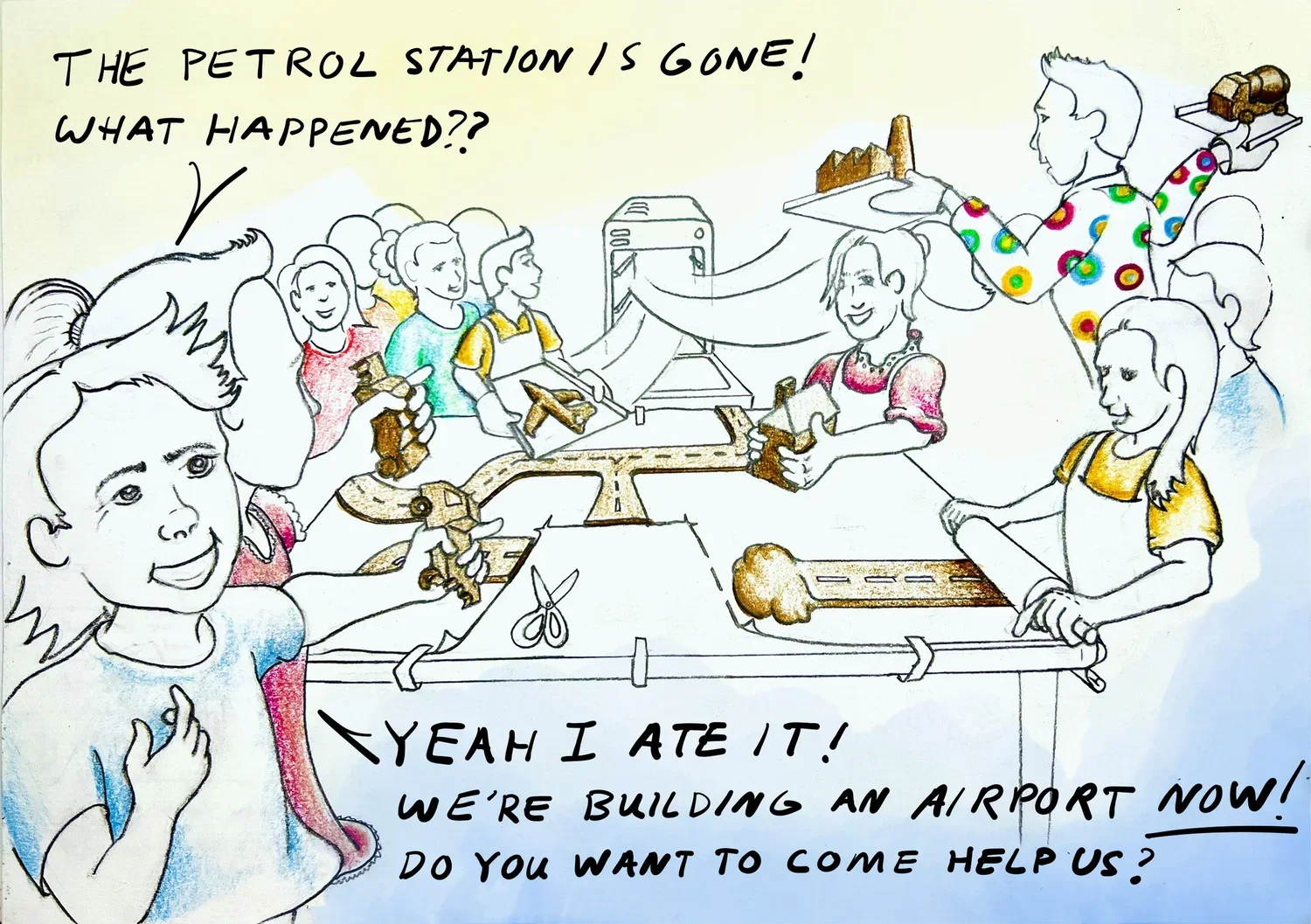
Imagine being with your young school friends again, building with many colours of cookie dough, a miniature model of places like your home, a farm, your town, your airport. How do they work today and what would make them amazing in the future? The only way to find out is to experiment building it and then digitally blow it up full scale all around you so you can live inside your cookie dough town.
So get your costumes on to play your role, because we’ve got real work to do. We need to build this town out!
And if you need someone to role play a professional role, just video conference in a parent who works in the same industry to play the character. OK, before we wrap it up for the day, let’s bake it.
Wait, a part of the town just disappeared from the map. What happened?
Johnny ate the petrol station!
“It needed an upgrade!” he calls out assertively from the other side of the table, as he puts in a new technology in that he says will allow flying cars to land from the far away city he was busy building on the adjacent table.
As the baking starts, we talk about the future of mobility. This was just day 1. Phew!
Each day, the map gets expanded and rebuilt with new challenges tested and solved using role playing and philosophical reflection. And you all get to take home your baked design. In a box or in your tummy.
Pilot two is a live event for creative teams to co-create a radically positive vision with their online community at a food Lab
Imagine congregating around a big table with your creative team. Each of you at the table brings your unique expertise. And backing each of you is an online community of specialists just like you, along with your most avid customers. They’re your ears on the ground for what’s trending in your wider community. They’re ready to respond immediately and expand on what you exhibit; with their ideas, insightful observations and free resources.
Together, you’ll build and test a radically positive future for products and spaces in your neighbourhood, tackling diverse challenges from the future of flight, to planning the future of cultural precincts and urban transport.
Brilliant ideas and radical shifts in perspective pop as you giggle and laugh your way through playing with a variety of doughs and ingredients to build out your vision.
In all that joy, among the most empowering shifts is discovering hidden strengths you didn’t know you had.
Having proven your concept design with the backing of your community’s generous resources pouring in online, you now have a much bigger team and feel energised to develop the project further. They just want to see this cool project get off the ground like you do.
And that’s design round one done!
Now it’s time to bake!
Moments later,.. The fresh smell of baked pastries and bread escapes as you open the oven. Do you all dine now, or test your emerging business model by auctioning off your designs to your community? Food delivery cyclists await your orders in the wings.
What Magic Garden 3 will support us Learn and develop
Learning ways to spark joy in effective creative leadership.
Prototyping the food lab with schools and creative teams, to learn ways (the behavioural sequences and culinary play equipment) that spark the joy of being creative; with joy being the foundational ingredient for:
Sparking creative genius and allowing each person’s innate leadership qualities to unfold.
Enjoying the ceremony of designing and therefore doing its work with integrity, to completion.
Developing ways of addressing seemingly complex problems with effective ways of designing that make light of the problem and feel effortless, quick and fun.
Being in our bodies, enjoying all that our bodily sensitivity is telling us about people, space and what we’re working on with great insight. So that we have clarity about what needs to get produced and how to progress with situations.
Making learner profiles lived and embodied instead of paperwork
Supporting each person develop their own rituals for making Learner Profiles a natural and practical part of their daily creative process.
A Learner Profile to this day documents your unique strengths to allow you to feel solid and founded in who and what you are and observe your tremendous forward progress. But when it stops being a document and becomes lived, it’s much stronger in doing that. And lasting!
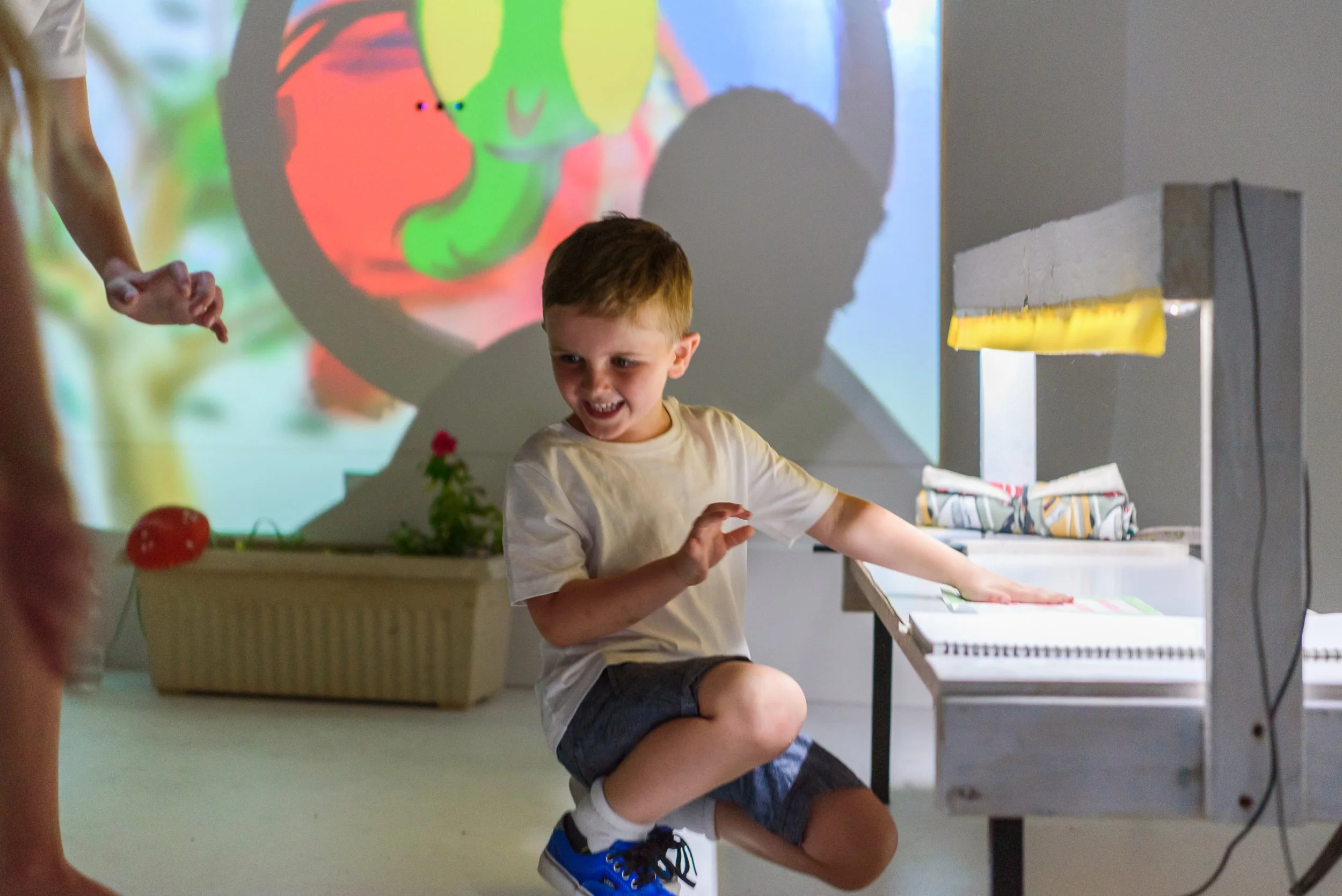
This photo of the boy in Magic Garden 2 illustrates how that looked for him. He sketched medals he wore that reflected to him and others the strengths he brought teamwork.
Prototyping a Co-creative Platform as a social media game.
To package the Design Thinking course as a “Back to Basics” approach that puts the joy back into being creative.
Will it be delivered as a cooking show, in tandem with being made practical for the office and classroom too? What format will support everyone enjoy the ceremony of Design Thinking? What allows you to ”Return to the the artist in you, (and) feel the joy.” (Antonietta Bua)
To learn in depth about our audience and starting point for growing as one in the market.
To refine the recipes of cookie dough and other foods to to work effectively in facilitating creative flow in different problem solving scenarios.
Preparing playground designs and food products for mass production.
Progress update
Cookie Dough Recipe perfected: I have developed 2 cookie base-doughs that keep their shape in the oven. This means we can build any shape and know it won’t deform by melting, shrinking or rising. They also taste good. In these photos I wanted to see if the dough would hold its shape as a bridge structure holding a light weight (more dough) ontop of it.
Form-making perfected: Because the program won’t allow time and resources to be wasted on creating conventional cookie cutters and trays in different shapes, I needed to develop a fast and easy way to create 3D forms using cardbaord wrapped aluminium foil: materials that are freely available in most home kitchens, schools and offices. Making these forms is such an unprecedented way of baking that it sparks joy. I couldn’t help laugh out loud as I saw it do the job perfectly and so simply.
Sweetener sensitivity perfected: One of the doughs (not depicted here) is designed so simply (only 2 ingredients) that it caters for all known food sensitivities. It also has the least possible impact as a stressor on the nervous system by ensuring there is no type of sweetener added while still tasting naturally sweet, though mild. This is to support a person with fine sensitivity remain in their natural state of being sharp and astute.
To establish makerspaces (and food labs) as clinics for detoxing A.I. and addictions to digital tech with the joy of being in the body.
To prototype such a makerspace so that we may observe what specific design features in both playspaces, play equipment and Arts & Crafts activities that effectively support the detox and spark the joy of being in the body as our primary function.
Developing a business plan for piloting the food lab, and then rolling these maker spaces out.
Let’s Work Together
Inspired to collaborate or have questions? Give me a call, I’d love to support.
Mobile / WhatsApp / WeChat / Signal: +61 416 858 303
krister@krister.designer@gmail.com
Sydney, Australia (Chatswood)